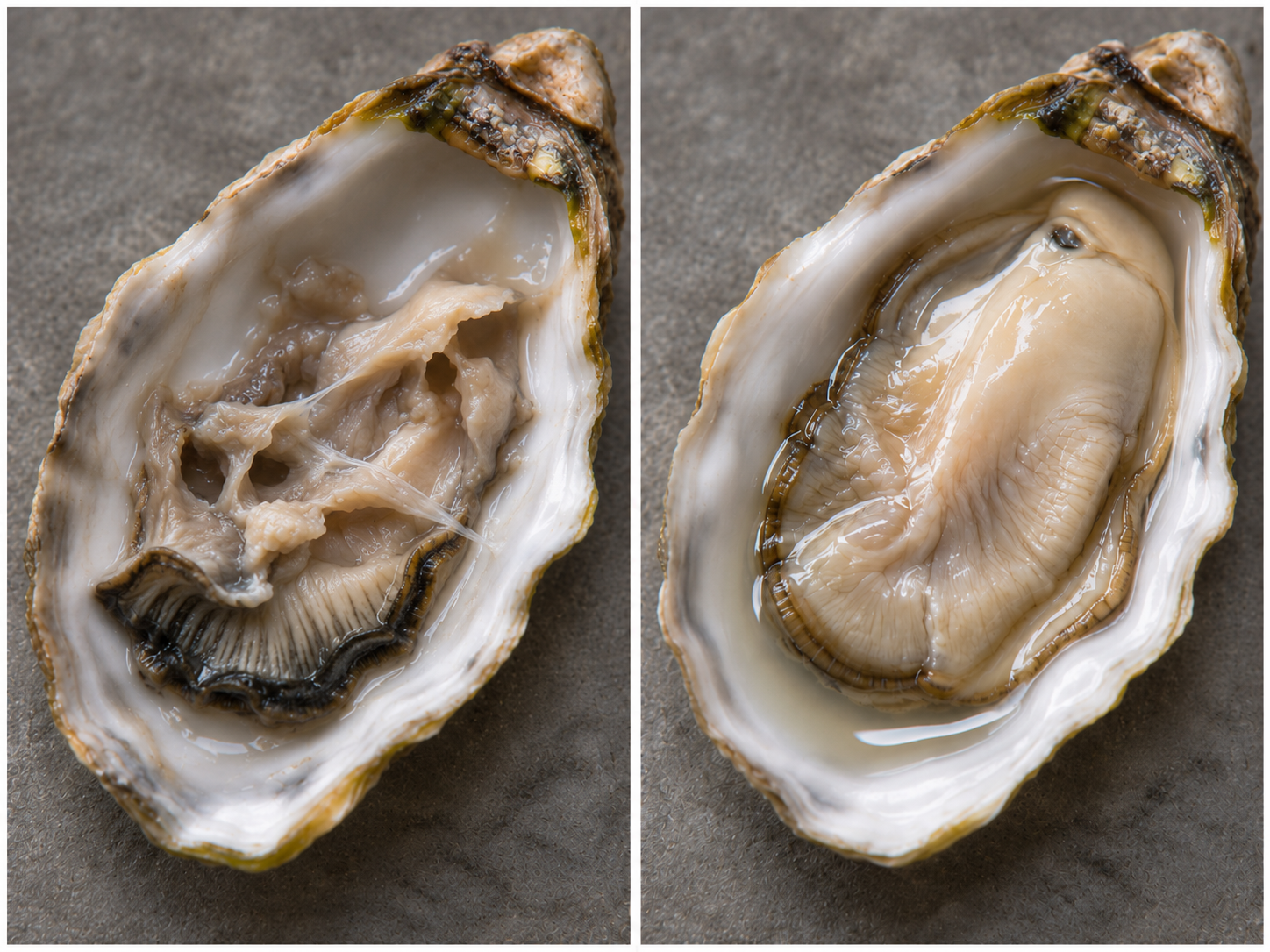
Why Two Oysters From the Same Box Can Taste Different
Updated: Sep 11
You order two oysters of the same variety. Same producer. Same harvest. Same box.
You eat the first one. Salty, clean and crisp. Then you eat the second. Sweeter. Fuller. Maybe a little creamier.
How can two supposedly identical oysters taste different? Because oysters are animals, not manufactured products.
Every oyster grows slightly differently
Even oysters growing beside one another are not completely identical. One might sit slightly higher in the water. Another may experience stronger currents. One shell may be deeper. Another oyster may filter slightly more food.
These small differences accumulate during the oyster’s life. By the time they arrive on your plate, they can produce subtle differences in meat size, liquor volume, texture, salinity, sweetness and finish.
Shell shape matters too
A deep-cupped oyster can retain more liquor than a flatter oyster. That changes the first impression.
One oyster might arrive at your palate with a larger burst of briny liquor, while another from the same batch may seem softer or sweeter simply because it holds less.
Oysters are biological
We sometimes expect food to behave like manufactured products. Open one bottle of a soft drink and it should taste exactly like the next bottle. Oysters don’t work that way.
There is natural variation. That is part of what makes eating them interesting.
Even the meat itself can vary
An oyster’s body condition changes with the environment. Food availability, temperature and reproductive cycle can all influence the fullness and texture of the meat.
So two oysters can share a label without being perfect copies of one another.
Is variation a bad thing?
Not necessarily. Within a good batch, slight differences are often part of the experience.
You may find yourself preferring one oyster over another even though both came from exactly the same box. This is also why we encourage people to taste several oysters rather than making a judgement from a single shell.
The Oyster Cart way
After more than a decade of opening oysters, we’ve learned not to expect absolute uniformity. We look instead for consistency within character.
An oyster should still express what makes that selection distinctive. But individual shells may whisper the story slightly differently.
That is one of the reasons oysters remain interesting even after thousands of them. No two shells are quite the same.
The easiest way to understand that natural variation is at the table — dine on freshly shucked oysters with us and compare them side by side.